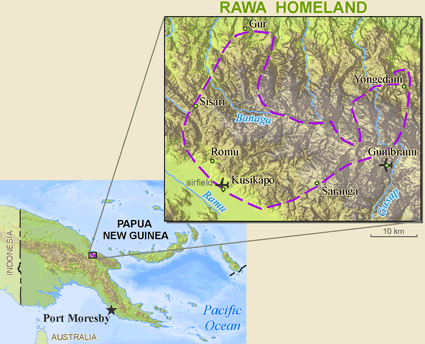
The Rawa people live in the rugged interior of Morobe Province in Papua New Guinea. Their communities are in remote highland and foothill regions marked by dense forest, steep ridges, and limited road access. Isolation has shaped much of their identity and daily life. Travel between villages often requires long walks along narrow bush paths or river crossings.
The Rawa speak the Rawa language, which belongs to the Trans–New Guinea language family. Tok Pisin is also used, especially in trade, education, and church contexts. Despite increasing contact with the outside world, the Rawa language remains a strong marker of ethnic identity and is central to communication within the community.
Historically, the Rawa lived in relatively small, clan-based settlements. Government patrols, mission activity, and the spread of education during the twentieth century gradually connected them more closely to national structures. Airstrips, mission stations, and limited infrastructure brought new opportunities and challenges. While modernization has reached some villages, many Rawa communities remain geographically isolated and dependent on subsistence agriculture.
Life for the Rawa today centers on gardening, family, and village relationships. Most families cultivate sweet potatoes, taro, bananas, sugarcane, and leafy greens in small garden plots carved from the forest. Coffee may be grown as a small cash crop in some areas, providing modest income when transport to market is available. Hunting and occasional fishing supplement the diet.
Meals are simple and based largely on root crops and vegetables, sometimes accompanied by pork or small game during special occasions. Food is typically cooked over open fires. Sharing meals reinforces bonds within the extended family.
Work is physically demanding. Men clear land, build houses, and tend larger garden plots, while women plant, harvest, cook, and care for children. Children assist with gardening and household tasks from a young age. Cooperation among relatives is essential for survival and stability.
Homes are often built from locally available materials such as wood, bamboo, and thatch, though some communities now include structures with metal roofing. Access to healthcare and education varies depending on location. Some children attend local primary schools, while others must travel long distances or board away from home.
Community life revolves around kinship and mutual responsibility. Bride price exchanges, funerals, and church gatherings are major social events that bring villages together. Singing is especially valued, and group worship or community meetings often include enthusiastic participation. Though modern influences such as mobile phones and radios are increasingly present, daily rhythms still reflect subsistence living and close community ties.
The Rawa are predominantly Christian, with most identifying with Protestant churches established through mission outreach in the region. Church attendance is common, and Sunday services are central to village life. Pastors and lay leaders guide worship, prayer, and teaching, often using Tok Pisin or the local language.
Christianity has significantly shaped moral standards and community expectations. Biblical concepts of marriage, forgiveness, and reconciliation influence social relationships. At the same time, elements of traditional belief in spirits and unseen forces may persist in worldview and daily concerns. Fear of sorcery or spiritual harm can still affect decision-making in some communities.
For many Rawa, Christian identity is sincere and heartfelt. Worship services, prayer meetings, and choir singing are vibrant expressions of faith. However, spiritual understanding and discipleship vary from village to village. Continued teaching from scripture is necessary so that believers grow in a clear understanding of salvation by grace through faith in Jesus Christ and freedom from fear-based practices.
Because there is a visible church presence, the Rawa have opportunity not only to deepen their own faith but also to participate in reaching neighboring groups in Asia where gospel access remains limited.
Greater access to healthcare would reduce preventable illness and maternal and child mortality in remote areas. Improved transportation and infrastructure would allow farmers to bring crops to market and obtain essential supplies. Strengthened educational opportunities would equip young people with skills for leadership and service.
Clear and consistent biblical teaching is essential for spiritual maturity and freedom from lingering fear of spirits or sorcery. Local church leaders would benefit from further training so they can faithfully disciple their congregations. A growing vision for mission could inspire Rawa believers to look beyond their own villages and share Christ with less reached communities nearby.
As outside influences increase, wisdom and discernment are necessary to navigate cultural change without losing commitment to Christ. The transforming power of Jesus remains central to meeting both visible and unseen needs.
Pray for improved healthcare, transportation, and educational opportunities in Rawa communities.
Pray for strong biblical discipleship and freedom from fear of spiritual forces.
Pray for well-trained and faithful church leaders who handle God's word accurately.
Pray that Rawa believers will become part of the gospel force reaching less evangelized peoples of Papua New Guinea.
Scripture Prayers for the Rawa, Erewa in Papua New Guinea.
https://www.peoplegroups.org
https://www.ethnologue.com
https://www.britannica.com/place/Papua-New-Guinea
| Profile Source: Joshua Project |